Production
An intervention can affect capacity, availability and daily operation.
AMELA combines engineering expertise, physically grounded models, simulation and optimization to investigate relevant alternatives and substantiate the strongest route.
Discuss your engineering challengeFor complex design, process, asset and system challenges.
The complication
In complex technical systems, a change rarely affects just one point. Production, safety, reliability, time, cost and other system components influence one another.
An intervention can affect capacity, availability and daily operation.
New configurations require a careful assessment of risks and constraints.
An improvement in one place can create new constraints or vulnerabilities elsewhere.
There is limited room to test alternatives in a live installation.
Investment, operation and the consequences of downtime need to be considered together.
The full consequences of a choice often become visible only after implementation.
In complex systems, it is not only whether a solution works that matters, but how it performs against the relevant alternatives.
Technical choices
Do not start with a solution; start with the technical choice in front of you.
Which intervention will measurably improve an existing installation?
Investigate performance, constraints and improvement opportunities before changing or replacing assets.
What happens to flow, heat and pressure when you change the installation?
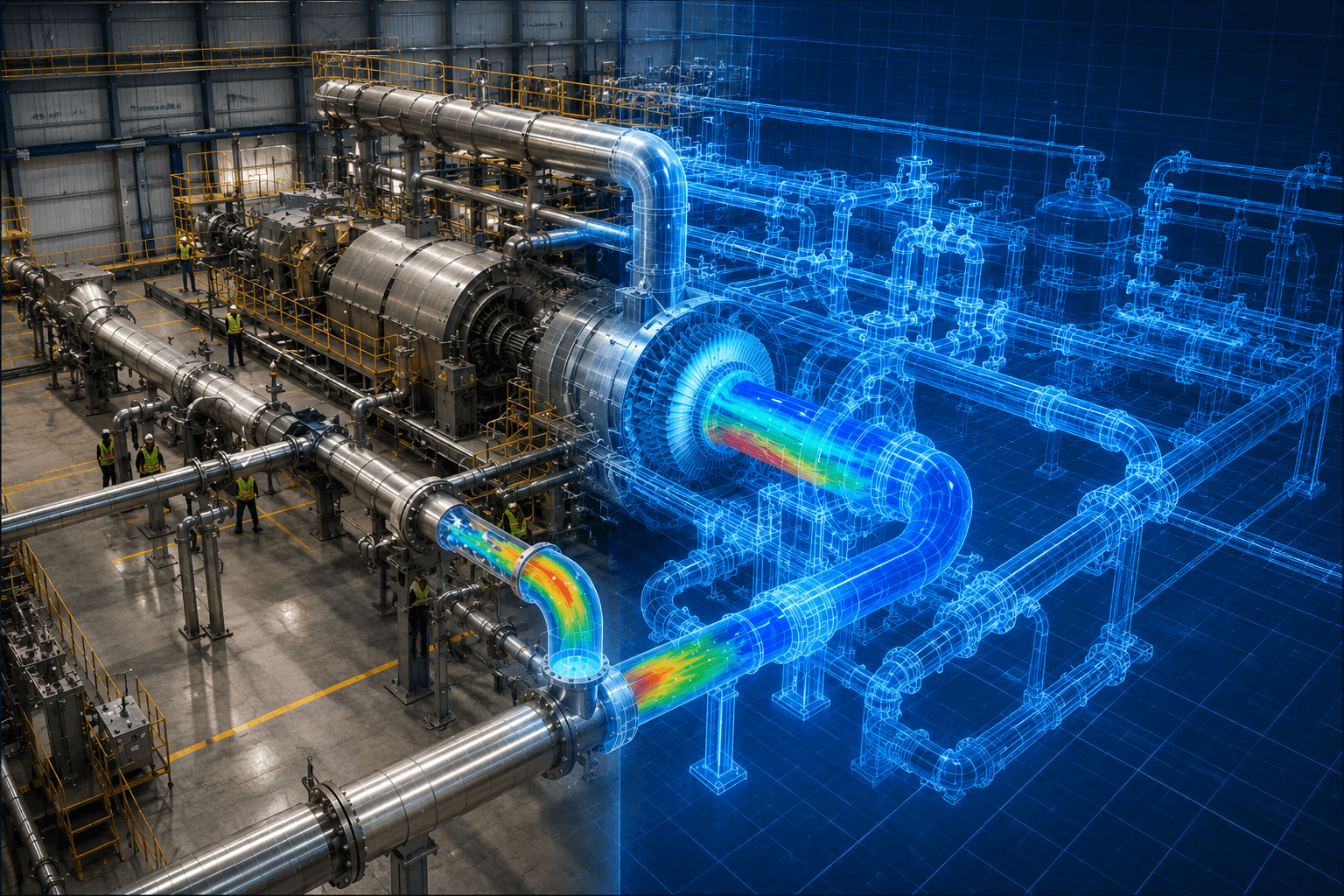
Make physical interactions visible and compare design, layout and setting choices.
Which change delivers the most value within your operation?
Compare technical routes across performance, reliability, risk and relevant cost.
How do you substantiate a complex transition or technology choice?
Structure options, test assumptions and translate technical analysis into a defensible decision.
Why AMELA
We combine domain knowledge and system understanding to clarify the relevant physics, constraints, interactions and alternatives.
With physically grounded models, simulation and, where relevant, optimization, we systematically investigate how different routes perform.
Assumptions, performance, trade-offs and limitations remain traceable, so the preferred route can be defended technically.
Test it virtually first
Virtual Prototyping is not a standalone product, but a core part of how AMELA approaches engineering challenges.
The real system
Changes to a live installation affect production, safety, time and budget.
The virtual prototype
A relevant digital representation helps investigate system interactions before implementation.
Test where possible before implementation, so avoidable risk becomes more visible.
The AMELA method
The method follows the technical question and the system — not the other way around.
Map the system, objective and constraints.
Use the operating context, engineering knowledge and relevant constraints as the starting point.
Build a relevant virtual representation.
Translate important physical behaviour and system interactions into a model fit for the decision.
Investigate scenarios and make the strongest route visible.
Compare alternatives, performance and trade-offs, and substantiate why one route is preferred.
The method makes engineering expertise more powerful: not simply a plausible solution, but a traceable choice between relevant alternatives.
Engineering in practice
With Virtual Prototyping AMELA mapped pressure loss, pump load and system behaviour up front, making clear which technical changes were needed for a safe, optimal PFAS-free installation.
Explore our PFAS transition approachThe decision
Which changes are needed for a safe PFAS-free installation?
Why difficult
New foam types change pressure and flow throughout the system.
Approach
Modelling pressure loss and pump load, comparing alternatives.
Outcome
A substantiated, safe investment decision.
Different engineering problem. Same decision challenge.
View more cases